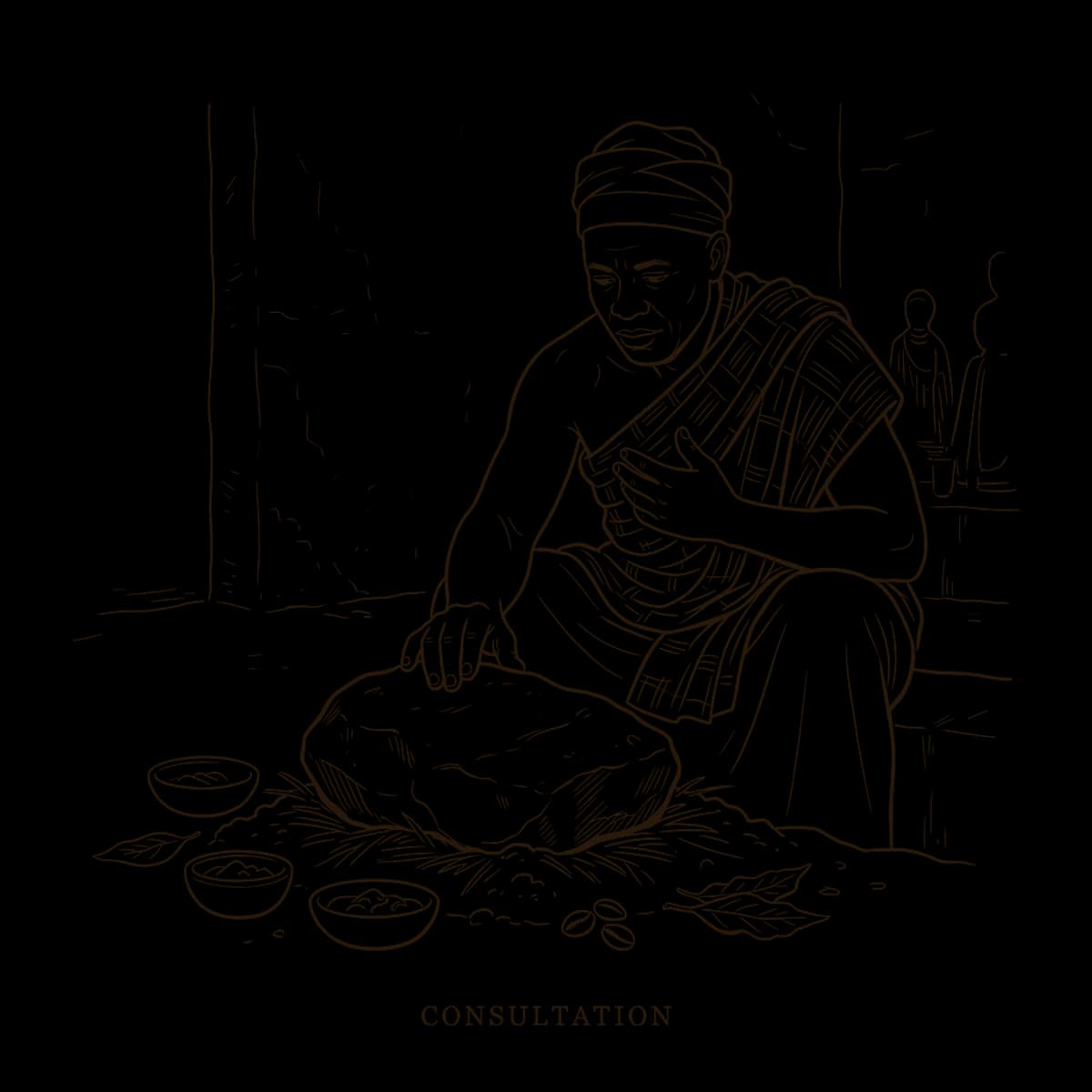
In a discreet chamber of the Glidji sanctuary, wrapped in a white cloth that only the high priests are permitted to handle, rests a stone. It has nothing spectacular at first glance: no gold, no gems, no elaborate carving. Yet this stone — the Kpessosso — is the most sacred object of the Guin-Mina people. Each year, at the heart of the Epe-Ekpe ceremony, it is extracted from its sanctuary for interrogation. What it reveals determines the year for an entire community.
The founding myth: an inheritance from Notsé
The origin of the Kpessosso goes back to the founding myth of the Guin people. When the ancestors left Notsé, the mother-city of the Ewe people located in present-day inland Togo, they carried with them sacred objects meant to maintain the link with the protective divinities. Among these objects, a stone, passed down from generation to generation, was entrusted to the most trustworthy priests.
According to oral tradition, this stone was given to King Foli Bebe by the ancestors themselves, with this instruction: it would be the channel through which the Guin people could continue to consult the divinities, wherever they might be. The stone thus became an oracle — not in the Greek sense of an enigmatic prophecy, but as an instrument for reading the signs that the invisible world addresses to the living.
The extraction ritual: gestures and prohibitions
The extraction of the Kpessosso stone follows a rigorous protocol that only the highest dignitaries of the Guin clergy know in its entirety. The ritual begins with a seven-day purification period, during which the Hunon priests abstain from certain foods, sleep in the sanctuary and multiply invocations to the 41 divinities of the pantheon.
On the appointed day, in absolute silence, the high priest unwraps the strips of white cloth that envelop the stone. It is then exposed to the light — a moment of extreme spiritual intensity, for it is at this precise instant that the signs become readable. The crowd, gathered outside the sanctuary, holds its breath.
Reading the colors: a sacred language
The reading of the stone rests on a chromatic code transmitted orally for centuries. Each color, each nuance, each alteration of the stone's surface since the previous year carries meaning. Bright white announces a year of peace, good harvests and prosperity for the community. Red warns of danger: conflict, epidemic, natural disaster. Black, the most dreaded color, signals the anger of the ancestors and the need to organize ceremonies of reconciliation and purification.
There are intermediate nuances that only experienced priests know how to interpret: a slightly yellowed white may indicate prosperity tinged with challenges; a brownish red evokes a danger that can be avoided through appropriate offerings. The reading is never binary: it is a subtle art that requires decades of practice and intimate knowledge of the Guin pantheon.
Once the signs are interpreted, the priests formulate a public declaration, often in metaphorical terms, that the village elders will translate into concrete recommendations in the following weeks. This declaration is awaited with anxiety mingled with reverence: it will guide collective decisions for the entire year.
The Kpessosso today: between secrecy and transmission
The Kpessosso continues to be the object of intense veneration by the Guin people. Its safekeeping is ensured by a lineage of priests who pass down the responsibility from generation to generation. The secrecy surrounding the stone is jealously protected: no photograph of the authentic stone has ever been published, and its exact location within the sanctuary is known to only a handful of initiates.
This opacity is not obscurantism. It is the very condition of the ritual's survival in a world where everything is exposed, photographed, disseminated. The keepers of the Kpessosso have understood that the stone's sacredness depends on its withdrawal from the profane gaze. It is because it is hidden that it is powerful.
The Kpessosso and Guin political life
The Kpessosso's role extends beyond the strictly religious sphere. For centuries, the omens read in the stone have influenced Guin kings' political decisions: declarations of war, alliances, successions. Even today, traditional authorities consult the Hunon priests and their interpretation of signs before making major decisions for the community.
A spiritual counter-power
In a society where temporal and spiritual power are separated, the Kpessosso functions as a counter-power mechanism. The Lawson and Adjigo kings govern, but the priests who read the stone are not subordinate to them. This separation ensures that no authority can free itself from the ritual framework without losing legitimacy.
Attempts to document the ritual
Several anthropologists have attempted to document the Kpessosso ritual, with varying results. Priests sometimes allow outside observers, but never in the inner sanctuary where the stone is kept. The available accounts are therefore partial, fragmentary, and often contradictory.
What is known with certainty
- The stone is kept in a Glidji sanctuary whose exact location is kept secret
- Only the highest dignitaries of the Guin clergy are authorized to handle it
- The extraction ritual is preceded by a seven-day purification period
- No photograph of the authentic stone has ever been made public
- The chromatic reading code is transmitted orally, from master to disciple