
On July 5, 1884, a German warship dropped anchor off the Togolese coast. On board was Gustav Nachtigal, an emissary of Emperor Wilhelm I and Chancellor Bismarck. Within a few days, Nachtigal signed treaties with several local chiefs, raised the German flag, and proclaimed the birth of the Schutzgebiet Togo—the German protectorate over Togo. For Aného, then known as Petit Popo, a thirty-year period began that would profoundly transform the city.
The Arrival of the Germans: Between Negotiation and Imposition
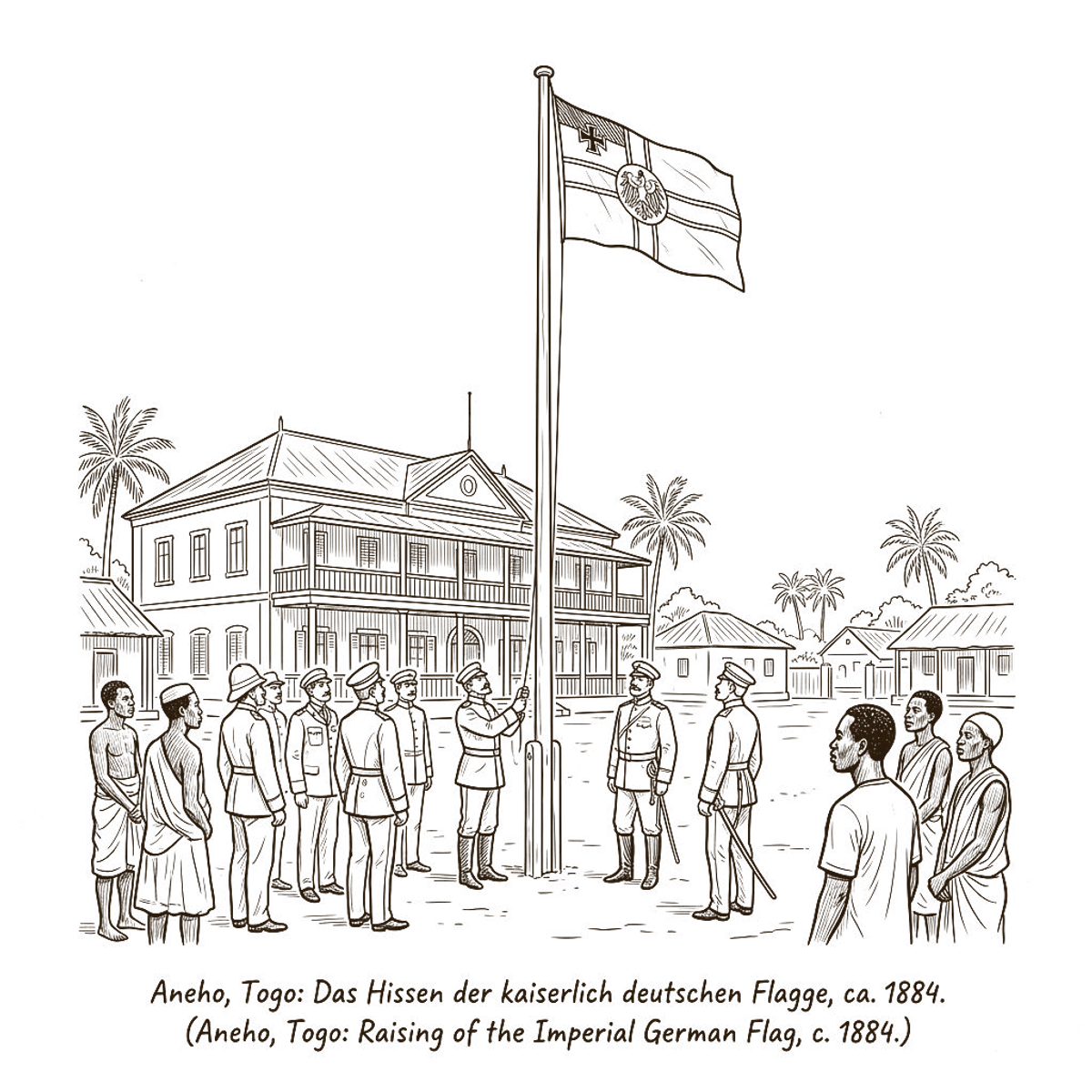
The German installation in Aného was not achieved through frontal violence, as was the case in other African colonies. The authorities in Berlin, aware of the fragility of their position on a coast already disputed by the British and French, favored an approach combining diplomatic negotiation and discreet military pressure.
The kings of Aného, particularly the Lawson dynasty, saw the arrival of the Germans as an opportunity as much as a threat. For decades, Petit Popo had suffered incursions from neighboring kingdoms and the uncertainties of coastal trade without possessing the military power necessary to assert itself. The offer of a German protectorate promised unexpected security. The Guin kings could not foresee that German protection would progressively transform into direct control, and then domination.
In 1886, Aného became the capital of Togoland. The city entered a phase of accelerated transformation. Administrative buildings were constructed. An imperial commissariat was established. The German language became mandatory in schools. Traditional Guin political structures were maintained in appearance, but their authority was increasingly undermined by decisions from Berlin, relayed by the local governor.
The SVD Mission: The Other Face of Colonization
Among the most influential actors of the German period in Aného was the Society of the Divine Word (SVD), a Catholic missionary congregation founded in 1875 in the Netherlands and established in Germany. Arriving in Aného in 1892, the SVD missionaries played an ambiguous role: they acted both as a relay for German influence and as occasional defenders of local populations against the abuses of the colonial administration.
Father Jakob Muller, the emblematic figure of the mission, undertook the construction of what would become Saints-Peter-and-Paul Cathedral, the first major Catholic edifice on the Togolese coast. He learned Mina, the local language, and forged close relationships with the Guin royal families. His letters and reports, preserved in the congregation's archives, are a precious source for historians today: they document daily life in Aného under the protectorate, tensions between different factions, epidemics, famines, and the complex relations between colonizers and colonized.
But the SVD mission was also an instrument of cultural colonization. The schools it opened taught in German. Converts were encouraged to abandon traditional religious practices, equated with "superstition." The missionary presence created divisions within Guin society, between those who adopted the new religion and those who remained faithful to the cult of the ancestors.
The Economy of the Schutzgebiet: Commerce, Forced Labor, Resistance
The German protectorate transformed Aného's economy. Berlin encouraged the production of export crops: palm oil, cotton, and cocoa. Plantations were created in the hinterland. The port of Aného, equipped with a metal wharf, became a hub of colonial trade.
This economic transformation had a high human cost. Forced labor, officially prohibited by texts but systematically practiced, was used to construct infrastructure: roads, bridges, and administrative buildings. The inhabitants of Aného and surrounding villages were requisitioned for corvées that sometimes lasted several weeks. Resistance was firmly repressed.
Protest took varied forms. Some inhabitants fled to the neighboring British Gold Coast, where the colonial regime was perceived as less harsh. Others organized boycotts of German-administered markets. The Lawson kings, in particular, used diplomatic channels to protest to Berlin against the abuses of local officials. The petition of Lawson III to Emperor Wilhelm II in 1895 testifies to this resistance through law, which contrasts with the armed revolts seen in other colonies.
1914: The Brutal End of the Schutzgebiet
On August 4, 1914, the Great War erupted in Europe. Togoland, a German colony surrounded by British and French territories, found itself on the front lines. On August 6, Franco-British forces launched an offensive. The German troops, vastly outnumbered, resisted for a few weeks before capitulating on August 26, 1914.
For Aného, the German defeat meant the end of an era. The German flag was lowered. Colonial officials were taken prisoner or expelled. German properties were seized. Togo was divided between France and Great Britain by a League of Nations mandate. Aného passed under French administration. The city that had been the heart of German Togoland became a mere sub-prefecture of French Togo.
The German Legacy: Vestiges and Memory
What remains of the German period in Aného today? Few buildings have survived the passage of time and the tropical climate. The foundations of the metal wharf are still visible at low tide. A few colonial-style houses, transformed into dwellings or shops, bear the trace of German architecture. Saints-Peter-and-Paul Cathedral, restored after being threatened by coastal erosion, remains the most imposing testament to this period.
But the most lasting legacy is perhaps intangible. The German period introduced institutions, administrative practices, and a language to Togo that influenced the country's subsequent development. It also left contrasting narratives in the Guin collective memory: the memory of endured domination, but also that of an era when Aného was the center of power, when local kings negotiated as equals with the Emperor's emissaries, and when the city radiated its influence across the entire coast.
Thirty years of protectorate is a short time in the long history of the Guin people. But these thirty years were enough to permanently transform the face of Aného and place the city into the grand colonial history of West Africa.
German Cultural Heritage in Aného
Beyond buildings and infrastructure, the German presence left lasting cultural marks in Aného. Certain Guin families retain German first names passed down over several generations: Friedrich, Wilhelm, Heinrich. German words slipped into the daily vocabulary of the elders, particularly in technical and artisanal fields.
What Remains of German in Aného
- Some families still possess documents in German: birth certificates, property deeds, correspondence.
- Saints-Peter-and-Paul Cathedral testifies to 19th-century German religious architecture.
- Oral histories evoke German administrative rigor, sometimes with nostalgia, sometimes with resentment.
- The National Archives of Togo in Lomé preserve German colonial registers, accessible to researchers.
Rehabilitating the German Period
Long ignored in the Togolese national narrative, the German period is now the subject of renewed interest. German and Togolese researchers are collaborating to digitize colonial archives. Twin city projects between Aného and German towns are under study. This rehabilitation does not aim to glorify colonization, but to recognize the complexity of a period that profoundly marked the city.
Gustav Nachtigal: The Man Who Raised the Flag
Gustav Nachtigal was not a military man, but a doctor and explorer. Before arriving on the Togolese coast in July 1884, he had spent five years exploring the Sahara and the central Sudan, where he nearly died of fever several times. Bismarck chose him for his knowledge of Africa and his ability to negotiate with local sovereigns. In a matter of days, Nachtigal signed treaties with several coastal chiefs and raised the German flag. He died of malaria in 1885, less than a year after giving birth to Togoland. His grave is located in Grand-Bassam, Ivory Coast, but his name remains tied to the founding of the German colony of Togo.
Daily Life Under the Protectorate
For the inhabitants of Aného, the German protectorate was not just about grand political decisions. It was also a transformation of daily life. The introduction of new crops (cocoa, coffee) altered the agricultural landscapes. The first bicycles appeared, imported by German merchants. German currency (the mark) began to circulate, competing with traditional cowries. The earliest photographs of Aného date from this period: they show dirt streets, thatched-roof houses, and the cathedral already under construction. Life was hard—colonial taxes were heavy, and corvées for road construction were unpopular—but it was also marked by a certain stability that contrasted with the decades of pre-colonial conflicts.
The Resistance of the Guin Kings
The kings of Aného were never passive collaborators. Lawson III, in particular, led a stubborn diplomatic resistance against the abuses of colonial officials. His petition to Wilhelm II, written in German with the help of missionaries, is a remarkable document: it uses European legal language to denounce violations of the protectorate treaty by the Emperor's representatives. This strategy of resistance through law, rather than through arms, characterizes the Guin relationship with colonial powers. It explains why Aného never experienced a major armed revolt, unlike other regions of Africa: the Guin kings understood that the military balance of power was unfavorable to them and chose the legal and diplomatic terrain instead.