
Few African cities carry the trace of their own history in their name. Aného, formerly Petit Popo, is one of them. Behind the Afro-Brazilian facades, sandy alleys, and shimmering lagoon lies a founding narrative that mixes forced migration, political genius, and an alliance with the sacred. Understanding the foundation of Aného means understanding how a people driven from their land managed to build a coastal kingdom that would become, two centuries later, the first capital of Togo.
The Migration from Accra: The Founding Exodus
The story begins around 1660 on the coast of present-day Ghana. Two distinct migratory waves would forge Aného's identity: the Mina (originating from Elmina) and the Guin (a branch of the Ewe people originating from the Accra region). Fleeing the joint pressure of the expanding Ashanti kingdom and commercial wars along the Gold Coast, the Guin, led by a charismatic chief named Foli Bebe, decided to leave Accra in search of a more peaceful land to the east. They would later join the Mina, already established in the region by the d'Almeida clan (founders of the Nlessi/Adjigo neighborhood), creating a dynamic of historic coexistence and rivalry.
The migration was not a disorganized flight. The Guin traveled in a structured formation: warriors at the front, families in the center, priests carrying sacred objects at the rear. They followed the coastline, swam across the Volta River or used makeshift boats, and progressed slowly eastward. Oral tradition remembers this crossing as a foundational ordeal: hunger, thirst, attacks from hostile groups, disease—all obstacles that forged the cohesion of the people on the march.
After several years of progress along the coast, Foli Bebe's scouts reached a lagoon area of striking beauty. A calm body of water, bordered by coconut palms and kapok trees, separated from the Atlantic Ocean by a thin sandspit. The site offered what the Guin sought: fresh water, fertile land, a defensible position, and sea access for trade. Foli Bebe decreed that the journey would stop here.
Glidji, the First Spiritual Capital
The first permanent settlement was founded around 1680 at Glidji, a few kilometers from present-day Aného. The choice of the site owed nothing to chance: the lagoon provided fish, the surrounding land allowed for maize and cassava cultivation, and proximity to the ocean opened the way for trade with European ships beginning to ply the coast.
But Glidji is not just a strategic site. It is a place laden with spiritual meaning. Here, Foli Bebe installed the sacred objects of the cult, including the Kpessosso stone. One tradition links that stone to Notsé, the mother-city of the Ewe peoples; since the Guin came from Accra, the link is a distant ancestral origin rather than a direct journey during the exodus. The first shrines were erected. Priests organized the worship of the 41 Guin deities. Glidji became the spiritual capital of the people—a role it still holds today, three centuries later.
Political organization was structured around the king and a council of elders. Foli Bebe established a chieftaincy system that combined temporal authority with spiritual legitimation: the king governs, but he does so in the name of the ancestors and with the blessing of the deities. This political model, based on the balance between the visible and the invisible, remains the matrix of Guin power to this day.
Petit Popo: Birth of a Merchant City
In the early 18th century, a second pole developed on the site of present-day Aného. Europeans, who began trading regularly with the coast, gave this trading post the name Petit Popo—as opposed to Grand Popo, another trading post located further east in present-day Benin. The name is believed to come from a deformation of the Portuguese "povo" (people) or a local term designating the coconut palms lining the beach.
Petit Popo quickly became an important commercial crossroads. The Guin exchanged palm oil, coconuts, dried fish, and textiles for European goods: firearms, gunpowder, alcohol, and manufactured cloth. The city's position, halfway between the Dutch trading posts of the Gold Coast and the Kingdom of Abomey, made it a popular stop for merchant ships.
Commerce enriched the city. Merchant families emerged, including the ancestors of the future Lawson dynasty. Two-story houses, inspired by Afro-Brazilian architecture, began to rise along the lagoon. Petit Popo was no longer a fishing village: it was a merchant city attracting traders from across the region.
A Kingdom Between Three Empires
Aného's geographical position was both a blessing and a curse. Situated on the border between the British zones of influence (to the west, in present-day Ghana) and French zones (to the east, in present-day Benin), the region became a strategic prize for colonial powers vying for West Africa at the end of the 19th century.
Guin kings, aware of the danger, practiced skillful diplomacy. They negotiated simultaneously with the Germans, French, and British, signing protectorate treaties that formally preserved their autonomy while conceding commercial rights. This balancing strategy worked for several decades. It allowed Aného to maintain de facto independence where other coastal kingdoms had been outright absorbed.
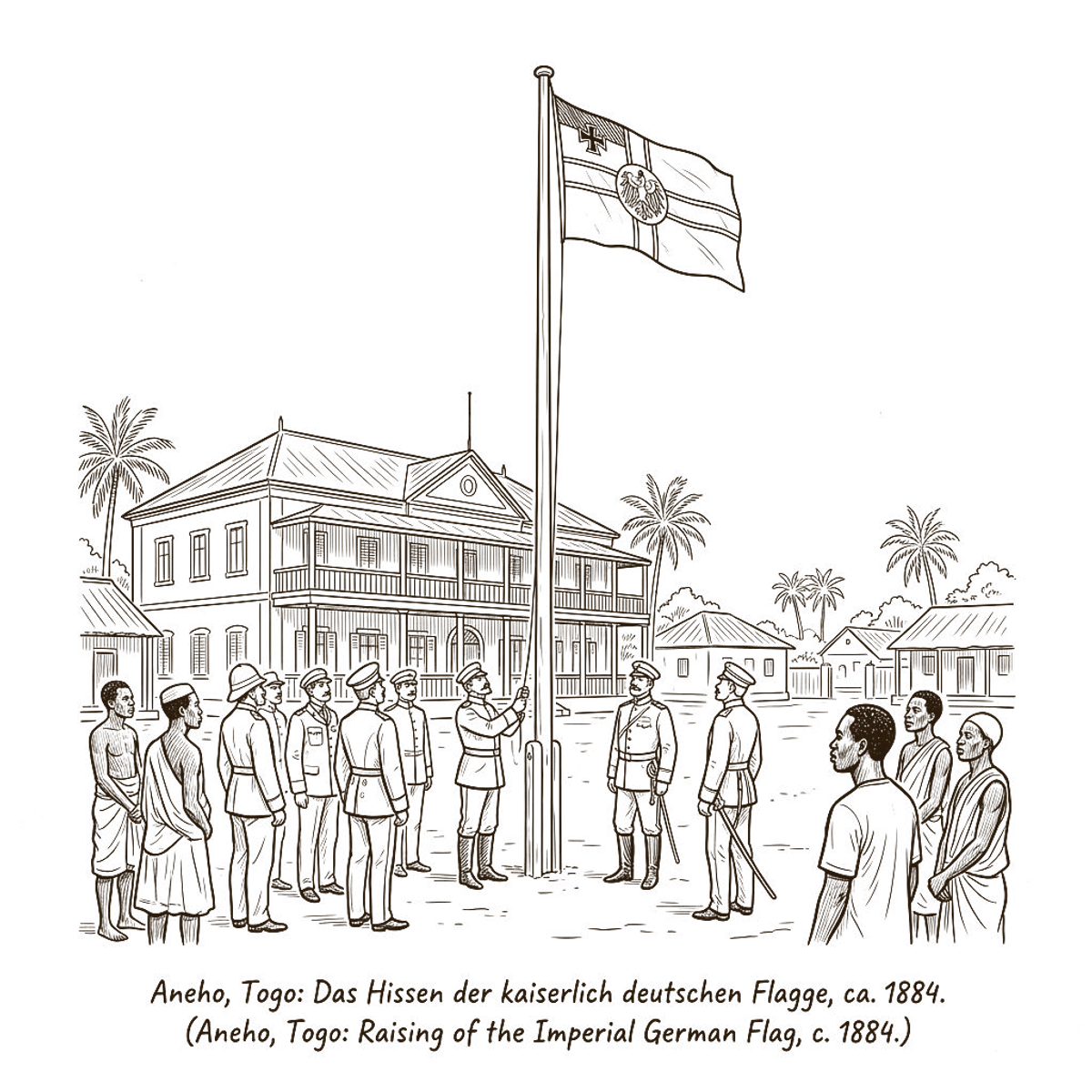
But the balance was fragile. In 1884, Germany proclaimed its protectorate over Togo, bringing Aného into its sphere of influence. Two years later, the city became the capital of the German colony of Togoland. The foundation of Aného as an independent kingdom had ended; its history as a colonial city had begun.
The Legacy of the Foundation
What Foli Bebe and the first Guins built upon arriving at the lagoon over three centuries ago has survived everything. The German colonization, the French mandate, Togo's independence, the political upheavals of post-colonial Africa: none of these disruptions erased the Guin identity forged during the foundation.
Even today, Glidji remains the spiritual heart of the people. The Epé-Ekpé ceremony attracts thousands of faithful each year. The descendants of Foli Bebe perpetuate the memory of the migration through songs and stories passed down from generation to generation. The lagoon that witnessed the arrival of the first migrants is still there, an immutable mirror of a history that refuses to be forgotten.
Aného is not a museum city. It is a palimpsest city, where each era has left its mark without erasing the previous one. Beneath the colonial houses, Guin foundations. Beneath the streets laid out by the Germans, the paths of the first migrants. Beneath the official name of Aného, the memory of Petit Popo. The foundation is never truly finished. It begins again with every generation that chooses to remember.
The Political Legacy of the Foundation
The way Foli Bebe organized Guin power at the end of the 17th century continues to influence Aného's political life today. The model he established—a temporal king in Petit Popo, a spiritual authority in Glidji—is a rare example of the separation of powers in pre-colonial Africa.
Principles of Guin Governance
- The king governs temporal affairs: commerce, diplomacy, justice.
- The Hunon priests hold spiritual authority: worship of deities, interpretation of signs.
- Neither power can act without consulting the other on major decisions.
- Women play a key role in mediation and the transmission of knowledge.
A Model That Survived Colonization
When the Germans arrived in 1884, they discovered an already sophisticated political structure. Unlike other regions where colonizers imposed their own chiefs, the German and later French authorities had to deal with the Guin kings. This institutional resilience partly explains why the Aného royalty has survived to this day, while other coastal kingdoms have disappeared.
Foli Bebe: The Charismatic Leader
The figure of Foli Bebe dominates the founding Guin narrative. Oral tradition describes him as a leader of exceptional political intelligence, capable of maintaining the cohesion of a people on the march during years of migration. His name means "he who opens the way" in Mina. He was not just a warrior: he was a diplomat who negotiated with the populations encountered along the coast, avoiding conflict whenever possible. His decision to stop the migration at Glidji was not a surrender but a calculation: the site offered everything the people needed, and continuing further east would have meant conflicting with already established kingdoms.
The Challenges of Migration
The Guin migration from Accra was no leisurely stroll. Oral accounts preserve the memory of the trials faced: the crossing of the Volta River, where entire families were nearly swept away by currents; diseases that decimated the ranks of the weakest; attacks from hostile groups who saw this column of migrants as easy prey. At each stage, Foli Bebe reorganized the caravan: warriors in the vanguard, families in the center, priests in the rearguard with the sacred objects. This military organization of the migration partly explains why the Guins kept their identity intact while other groups scattered.
Glidji and Petit Popo: Two Poles, One People
The distinction between Glidji (spiritual capital) and Petit Popo (commercial capital) is not an accident of history. It reflects a Guin conception of power where the temporal and spiritual were separated from the beginning. Glidji houses the shrines, sacred objects, and the authority of the priests. Petit Popo manages commerce, external relations, and diplomacy. This bipolarity allowed the Guin people to survive the upheavals of subsequent centuries: when Petit Popo fell under colonial domination, Glidji preserved the soul of the people. When Glidji was threatened, Petit Popo mobilized its commercial resources to defend it.