
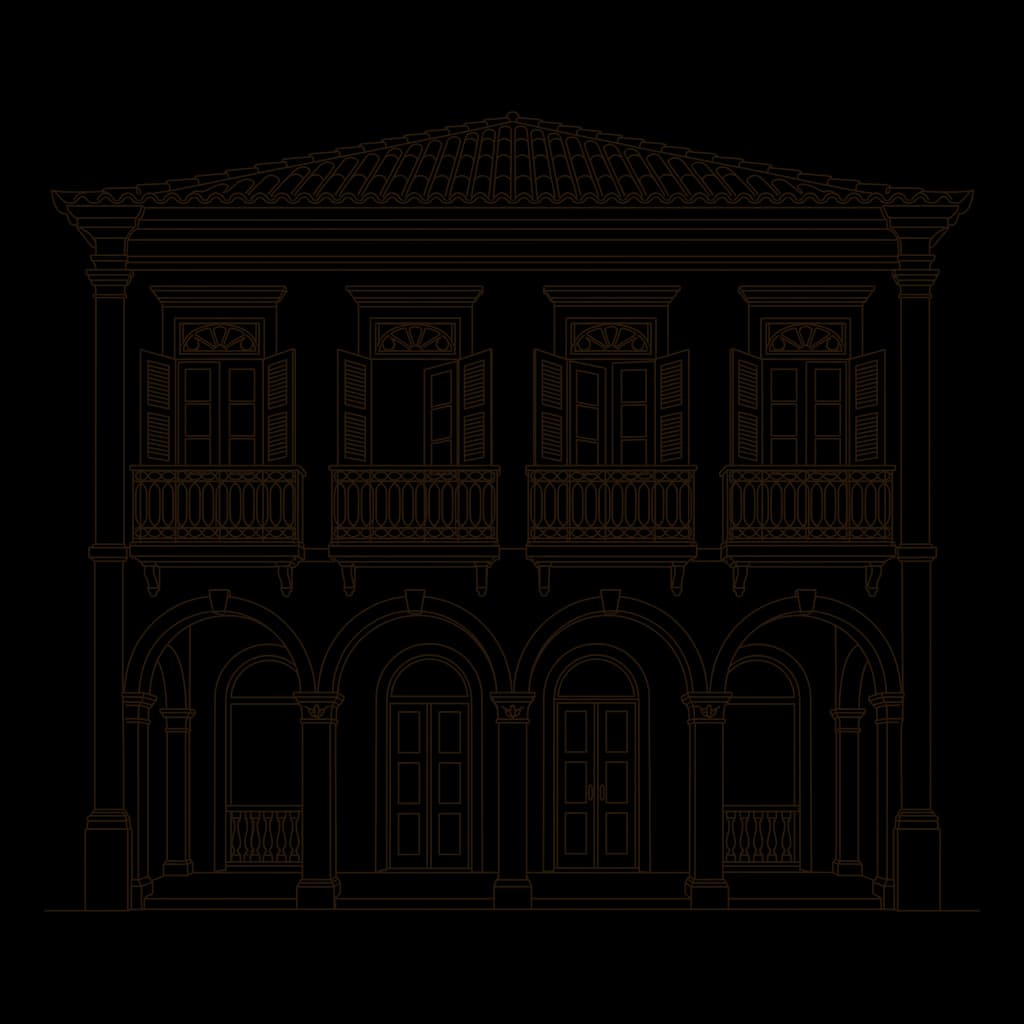
In the heart of Aného, in the neighborhood that bears its name, stands a building whose history alone summarizes two centuries of power, diplomacy, and cultural resistance. The Lolan Palace is not a monument frozen in the past: it is a living institution where, even today, the descendants of the Lawson kings receive visitors, settle customary disputes, and perpetuate the memory of a dynasty that shaped the destiny of Petit Popo.
The Origin of the Name: The Caiman Marsh
The name Lolan carries within it the original geography of the place. In the Mina language, Lo means caiman (crocodile), and Lolamé designates the place where caimans live. When Georges Akuété Zankli Lawson I returned from England in 1810 and sought a location to establish his residence, he chose a marshy plot of land next to the concession of his older brother, Laté Avla, in the Badji quarter.
This choice was not insignificant. The marsh, called babadji in Mina, was shunned by other families. But Lawson I saw a strategic advantage: water offered natural protection, and the caimans populating the area were considered spiritual guardians in Guin cosmogony. By building his palace on this inhospitable land, Lawson I affirmed his singularity—that of a man who had crossed the Atlantic, spoken with the kings of Europe, and did not intend to bow to local conventions.
The palace took the name Lolan, and the caiman became the emblem of the clan. Even today, the caiman motif appears on certain ceremonial objects of the family.
The Foundation of the Lolan Kingdom
On March 30, 1821, Georges Akuété Zankli Lawson I officially proclaimed the foundation of the Lolan Kingdom. This political act crowned thirty years of meteoric rise: having left for England as a simple interpreter, he returned to Petit Popo as a seasoned businessman, speaking English and Portuguese, capable of negotiating on equal terms with European captains.
The foundation of the kingdom was not without tensions. The traditional authorities of Glidji, the spiritual Guin kingdom founded a century earlier, looked unfavorably upon the emergence of a competing power. But Lawson I maneuvered skillfully: he did not contest Glidji's spiritual primacy, and presented the Lolan Kingdom as a temporal authority, linked to commerce and relations with Europeans. This distinction between spiritual power (Glidji) and temporal power (Lolan) still structures Aného's traditional geopolitics today.
Architecture Between Two Worlds
The current Lolan Palace is not the original building. The first palace, built in 1810, was likely a structure made of local materials—wood, earth, palm fronds. Over the decades, and especially from Lawson III (1883-1906) onward, the building was progressively transformed to adopt the Afro-Brazilian style characteristic of the coast's great residences.
The architectural elements that strike visitors today are typical of this hybridization:
- A symmetrical two-level facade, inspired by Brazilian colonial houses
- Wrought-iron balconies, imported or manufactured locally based on Bahia models
- A central patio that organizes circulation and family life
- Massive carved wooden doors, adorned with geometric motifs
The interior of the palace houses the family archives, including the famous Grand Livre des Lawson, as well as portraits of successive sovereigns and ceremonial objects. The audience hall, where the king still receives visitors and litigants, is furnished with a sobriety that contrasts with the historical richness of the premises.
The Palace in Togolese Political Life
The Lolan Palace is not a museum. It is a center of power that has played a role in the great moments of Togolese history. It was here that Lawson I received the Reverend Thomas Birch Freeman on March 29, 1843—the first Methodist missionary to set foot on Togolese soil. It was here that the first school in Togo was founded in 1852, with teachers from Sierra Leone, Nigeria, and Liberia. It was here that treaties with the German, and later French, authorities were negotiated, and where petitions sent to Berlin and Paris were prepared.
Since 1960, the Lolan Palace has shared Aného's royal legitimacy with the Adjigo throne (located in the Nlessi neighborhood), in a unique dual royalty configuration in Togo. Historically, the Adjigo clan (of Mina descent and founded by Francisco d'Almeida) claims primacy of settlement, while the Lawson clan (of Guin descent) established itself through its commercial and diplomatic power. This duality, endorsed by President Sylvanus Olympio in 1961 to appease centuries-old tensions, allows both palaces to coexist peacefully today. Each manages its clan's affairs according to customary rules, jointly participating in the city's major ceremonies.
Visiting the Lolan Palace
The palace is located in the Lolan neighborhood, in the heart of Aného. It is accessible on foot from the city center. Visits are possible upon request to the royal family, preferably through a licensed local guide. It is recommended to arrive in respectful attire and to avoid taking photographs inside without explicit permission. Traditional audiences are held on certain days of the week; visitors may attend as simple observers, in silence and with respect for conventions.
The Palace and Daily Life
The Lolan Palace is not an empty museum. Families still reside there, traditional audiences are held every week, and the children of the clan learn the history of their lineage.
A Day at the Palace
- Morning: customary audiences. Litigants come to present their disputes to the elders.
- Midday: the collective meal, served in the central patio, where members of the extended family gather.
- Evening: the youngest listen to the stories of the elders, memorizing genealogies and great deeds.
Ceremonies at the Palace
The palace regularly hosts ceremonies that punctuate the life of the clan:
- Traditional weddings, where families negotiate the dowry according to customary rules.
- Funerals of clan members, which can last several days.
- Guin New Year celebrations (Epé-Ekpé), where the king receives the homage of the community.
- Visits from foreign delegations and researchers who come to consult the family archives.
The Architecture of the Palace: A Mixed Style
The current Lolan Palace is the result of several construction and renovation campaigns spanning over a century. The original building, constructed in 1810 by Lawson I, was likely a modest structure made of local materials. Successive expansions, financed by the profits of commerce, gradually transformed the residence into an imposing edifice. The current style, which mixes Afro-Brazilian influences with adaptations to the coastal climate, dates mainly from the period of Lawson III (1883-1906). The wrought-iron balconies were imported from Hamburg. The cement tiles of the central patio were manufactured in Lomé based on European models. The carved doors were made by local artisans trained in Brazilian techniques.
Royal Audiences Today
The Lolan Palace is not a frozen museum. Every week, traditional audiences are held there. Litigants come to present their disputes to the elders of the clan. The most common cases involve land conflicts, family disputes, and inheritance issues. The king or prince regent listens, consults, and renders a decision based on Guin customary law. These audiences are public: visitors can attend in silence, provided they respect the dress codes and do not intervene. It is one of the rare opportunities for a foreigner to see a pre-colonial legal institution that has survived everything functioning live.
The Palace and National Memory
In 2019, the Togolese government inscribed the Lolan Palace on the indicative list of national heritage, the first step toward definitive classification. This belated recognition is the result of decades of advocacy by the Lawson family and Togolese historians. Classification would pave the way for funding to restore and preserve the building, which is threatened by coastal humidity and a lack of maintenance. For Aného, it would also be a symbolic recognition: the palace of its kings would finally be recognized as a common good of the Togolese nation.