
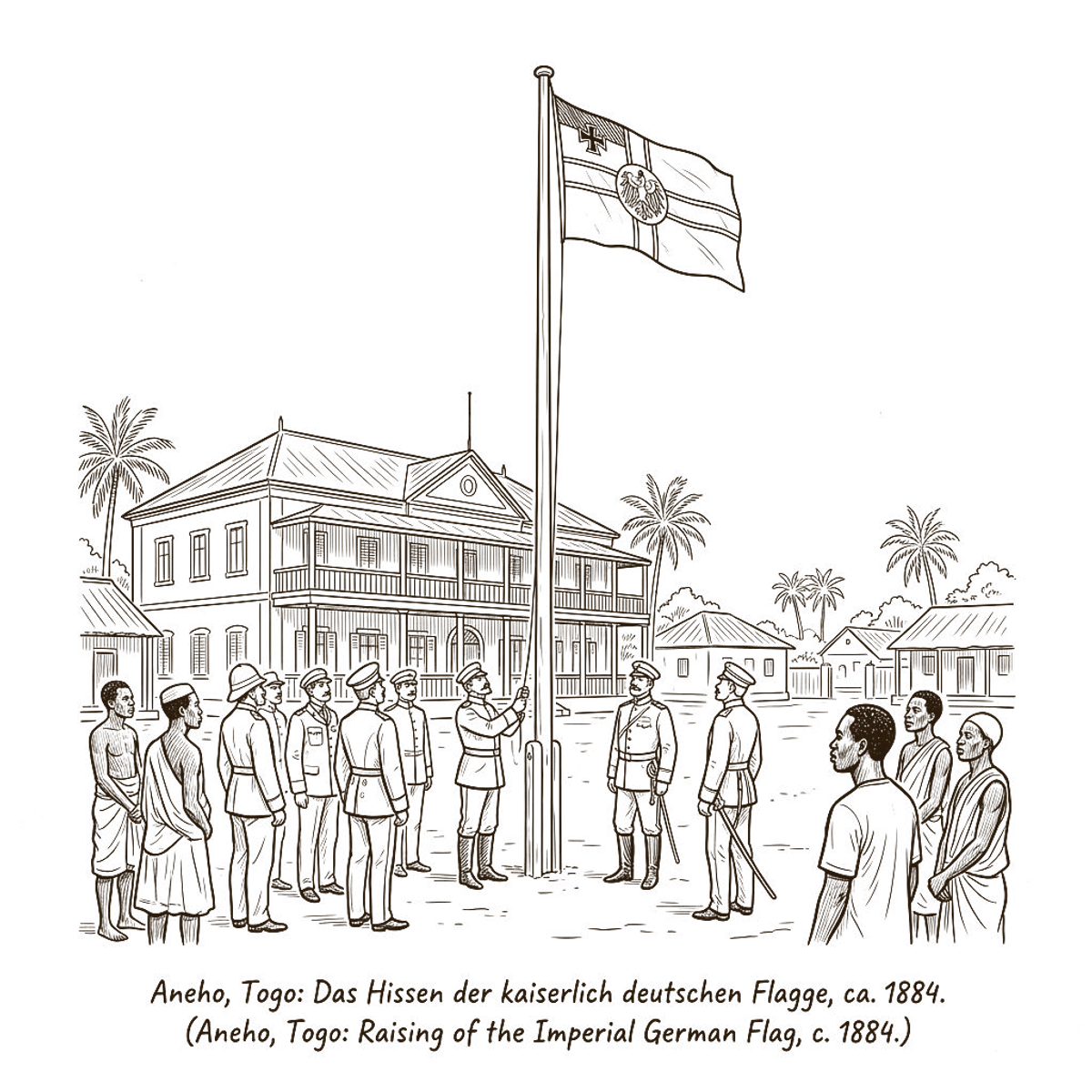
When the last German soldiers surrendered to Franco-British forces in August 1914, Aného changed hands for the second time in thirty years. The city that had been the capital of German Togoland passed under French administration, first as an occupied territory, then as a League of Nations mandate. This period, which lasted until Togo's independence in 1960, is the longest colonial tutelage imposed on Aného.
The French Installation
Unlike the Germans, the French did not make Aného their capital. Lomé, already the seat of the governorate since 1897, remained the administrative center. Aného became a simple interior district, losing the privileged status it had under the previous regime. This demotion was experienced as a humiliation by local elites.
The French administration imposed its structures methodically. Public schooling in French became mandatory. Local languages were excluded from education—a student caught speaking Mina in the schoolyard was punished. Modern taxation replaced traditional collection systems. Mandatory military recruitment sent young Guin men to fight under the French flag during both World Wars.
Guin children learned to read and write in the colonizer's language. A Francophone elite emerged from this mold, which would play a key role in the march toward independence. But this ascent came at a price: the progressive severance from oral culture and traditional knowledge.
Resisting the French Presence
French domination was not passively accepted. The royal families of Aného, notably the Lawsons, continued to exert an influence parallel to the colonial administration. Traditional ceremonies maintained social cohesion. The Guin commercial network, inherited from the German and Afro-Brazilian periods, preserved economic autonomy that limited French control.
Political movements took shape in the 1940s. The Committee of Togolese Unity (CUT), founded by Sylvanus Olympio, became the main vehicle for independence demands. Although born in Kpandu and raised in Lomé, Sylvanus Olympio was the direct heir of the great Afro-Brazilian bourgeoisie originating from the Aného and Agoué region (his grandfather, Francisco Olympio Silva, having settled there). Olympio, educated at the London School of Economics, spoke English, French, German, and Mina. He embodied the synthesis of influences that ran through Aného and used his mastery of European codes to carry the message of independence before international bodies. The local economy also transformed with the introduction of new export crops (copra, cassava) and the reorganization of road infrastructure linking Aného to the rest of the coast, anchoring the city in the commercial network of French West Africa (AOF).
Toward Independence
In 1956, French Togo obtained the status of an autonomous republic within the French Union. This was a first victory. Four years later, on April 27, 1960, Togo proclaimed its independence. Sylvanus Olympio became its first president. For Aného, it was a moment of intense pride: the son of the soil, the heir to the Lawsons and Olympios, was now head of state.
The French legacy remains visible: the language, the administrative and legal system, the road infrastructure. But it overlays previous layers—Guin, Afro-Brazilian, German—without erasing them. Aného is perhaps the only city in Togo where you can hear, in a single conversation, words in Mina, French, German, and Portuguese.